
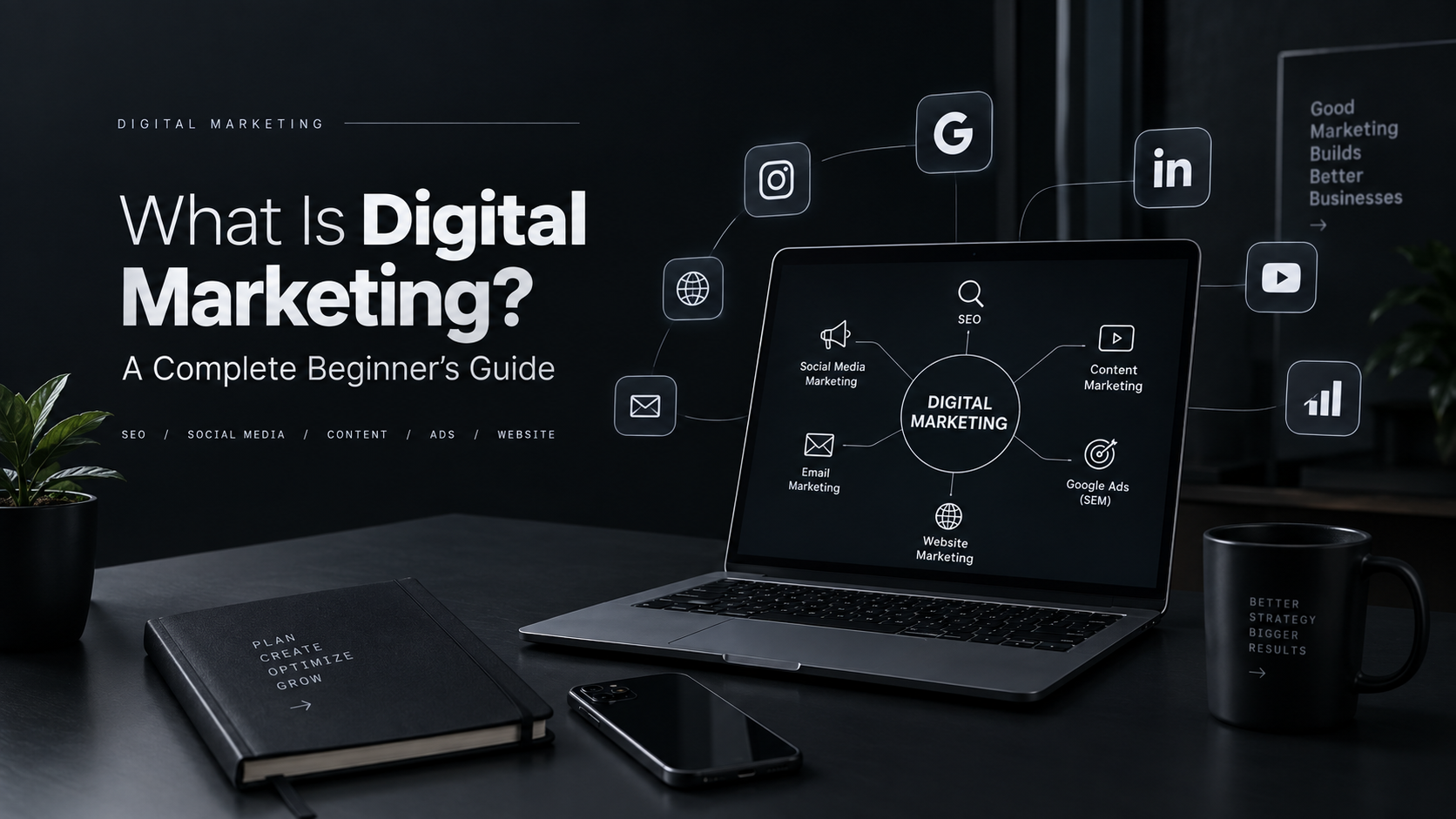
In today’s digital world, customers spend a significant amount of their time online. They search for products on Google, discover brands on Instagram, watch videos on YouTube, read reviews, and communicate with businesses through websites and social media.
This is where digital marketing becomes important.
Whether you are a small business owner, freelancer, startup, or established company, having a strong digital marketing strategy can help you reach the right audience and build a stronger online presence.
In this guide, we will explore what marketing is, its major types, its benefits, and how businesses can get started.
What Is Digital Marketing?
Digital marketing refers to marketing activities performed through digital channels to promote a business, product, service, or personal brand.
Unlike traditional marketing methods such as newspapers, television, radio, and printed advertisements, digital marketing allows businesses to connect with their target audience through online platforms.
Some common digital marketing channels include:
- Search engines
- Websites
- Social media
- Online advertising
- Content platforms
- Video platforms
For example, when someone searches Google for a service and finds a business website, that business is using digital marketing to reach a potential customer.
Why Is Digital Marketing Important?
The way people discover and interact with businesses has changed significantly.
Before making a purchase, customers often search online, compare different options, read reviews, and check social media profiles.
A strong digital presence can help a business:
- Reach potential customers online
- Increase brand awareness
- Generate leads
- Build customer trust
- Drive website traffic
- Increase sales
- Understand customer behavior
- Compete with larger businesses
For small businesses, marketing can also provide opportunities to reach a specific local audience without depending entirely on traditional advertising.
Major Types of Digital Marketing
Digital marketing includes several different strategies. Each one has a different purpose and can be used depending on the goals of a business.
1. Search Engine Optimization (SEO)
Search Engine Optimization, commonly known as SEO, is the process of improving a website so that it can appear more prominently in search engine results.
For example, if someone searches for:
“digital marketer in Malappuram”
businesses and professionals who have optimized their online presence may have an opportunity to appear in relevant search results.
SEO generally involves areas such as:
- Keyword research
- On-page SEO
- Technical SEO
- Content creation
- Link building
- Local SEO
- Website optimization
SEO is especially useful for businesses that want to attract people who are actively searching for their products or services.
2. Social Media Marketing
Social media marketing involves using platforms such as Instagram, Facebook, LinkedIn, and other social networks to build awareness, engage audiences, and promote products or services.
Businesses can use social media to:
- Share educational content
- Showcase products
- Build their brand
- Communicate with customers
- Generate leads
- Increase website traffic
For example, a local business can use Instagram to showcase its products, answer customer questions, and direct interested users to its website or WhatsApp.
3. Content Marketing
Content marketing focuses on creating and distributing useful content for a specific audience.
Examples include:
- Blog posts
- Videos
- Infographics
- Guides
- Case studies
- Social media posts
- E-books
A business that consistently publishes helpful content can educate its audience and build credibility over time.
For example, a digital marketing professional could publish articles about SEO, social media marketing, website optimization, and online advertising.
4. Search Engine Marketing and Online Advertising
Search Engine Marketing, often associated with paid search advertising, allows businesses to display advertisements to people searching for relevant products or services.
Businesses can use platforms such as Google Ads to target specific keywords, locations, audiences, and other parameters.
Unlike SEO, which focuses on organic search visibility, paid advertising involves paying for advertising placements.
5. Email Marketing
Email marketing involves communicating with customers or potential customers through email.
Businesses can use email marketing to send:
- Newsletters
- Product updates
- Offers
- Educational content
- Event announcements
- Follow-up messages
Email marketing can be particularly useful for maintaining relationships with existing customers.
6. Website Marketing
A website is often the central part of a business’s digital presence.
A well-designed website can help businesses:
- Explain their services
- Display products
- Generate leads
- Collect inquiries
- Build credibility
- Provide contact information
However, simply having a website is not enough. Businesses should also focus on website usability, mobile responsiveness, page speed, SEO, content, and conversion opportunities.
7. Local SEO
Local SEO focuses on improving a business’s visibility for location-based searches.
For example:
- Digital marketer in Malappuram
- SEO services in Kerala
- Web developer near me
- Digital marketing agency in Calicut
Local SEO can be particularly valuable for businesses that serve customers in specific cities, towns, or regions.
How Does Digital Marketing Work?
Digital marketing usually starts with understanding the target audience.
A business needs to identify:
- Who are the potential customers?
- What problems do they have?
- What are they searching for online?
- Which platforms do they use?
- What type of content do they prefer?
- What action should they take?
After understanding the audience, a business can select suitable digital marketing channels.
For example, a local restaurant might focus on:
Google Search + Local SEO + Instagram + Website
A B2B company might focus more on:
SEO + LinkedIn + Content Marketing + Email Marketing
The right strategy depends on the business, audience, industry, budget, and goals.
Benefits of Digital Marketing for Small Businesses
Digital marketing is not only for large companies. Small businesses can also use online marketing to develop their presence and reach potential customers.
Reach a Targeted Audience
Digital platforms allow businesses to target audiences based on factors such as location, interests, search behavior, and demographics, depending on the platform and campaign.
Build Brand Awareness
Consistent content across websites and social media can help people become familiar with a brand.
Generate Leads
Businesses can use websites, landing pages, social media, search engines, and advertising campaigns to generate inquiries from potential customers.
Measure Results
One of the major advantages of marketing is the ability to measure many aspects of a campaign.
Businesses can analyze metrics such as:
- Website traffic
- Engagement
- Leads
- Clicks
- Conversions
- Search visibility
- Advertising performance
This data can help marketers understand what is working and where improvements may be needed.
Digital Marketing vs Traditional Marketing
Traditional marketing uses channels such as television, radio, newspapers, billboards, brochures, and other offline methods.
Digital marketing uses online channels such as websites, search engines, social media, email, and online advertising.
The two approaches are not necessarily competitors. Depending on the business, a marketing strategy can combine both traditional and digital methods.
The important factor is choosing channels that effectively reach the intended audience.
How to Start Digital Marketing as a Beginner
If you are new to DGM, you do not need to learn everything at once.
A simple learning path is:
Step 1: Understand Marketing Fundamentals
Learn about:
- Target audience
- Customer journey
- Branding
- Value proposition
- Marketing funnels
Step 2: Learn SEO
Start with keyword research, on-page SEO, technical SEO, and content optimization.
Step 3: Learn Social Media Marketing
Understand how different platforms work and how businesses can create useful content for their audiences.
Step 4: Learn Content Marketing
Practice writing blog posts, social media content, website copy, and other useful resources.
Step 5: Learn Analytics
Understand how to measure website traffic, engagement, leads, and conversions.
Step 6: Build Practical Projects
The best way to develop your skills is to apply what you learn.
Create a website, optimize its SEO, publish content, manage a social media page, or work on a real business project.
Common Digital Marketing Mistakes
Beginners and businesses often make several common mistakes.
Focusing Only on Social Media
Marketing is much broader than social media. SEO, content, websites, email, search advertising, and analytics can also play important roles.
Not Understanding the Target Audience
Creating content without knowing who you are trying to reach can make marketing efforts less effective.
Ignoring SEO
A website can look professional but still struggle to attract organic search traffic if SEO is ignored.
Creating Content Without a Strategy
Publishing random content without clear goals can make it difficult to build consistent growth.
Not Measuring Results
Without tracking relevant metrics, it becomes harder to understand which marketing activities are contributing to business goals.
Frequently Asked Questions
What is digital marketing in simple words?
Digital marketing is the promotion of a business, product, service, or personal brand through online channels such as search engines, websites, social media, email, and digital advertising.
Is digital marketing suitable for small businesses?
Yes. Small businesses can use digital marketing to build awareness, reach potential customers, generate leads, and develop their online presence.
What is the most important part of digital marketing?
There is no single strategy that is best for every business. The right combination depends on the business goals, target audience, industry, location, and available resources.
Is SEO part of digital marketing?
Yes. SEO is one of the major areas of digital marketing and focuses on improving organic visibility in search engines.
How long does digital marketing take to show results?
The timeline depends on the strategy. SEO and content marketing may require consistent effort over time, while paid advertising can generate traffic more quickly. Results vary based on the business, competition, strategy, and execution.
Final Thoughts
Digital marketing has become an important part of building and growing a modern business.
From SEO and social media marketing to content marketing, websites, email marketing, and online advertising, businesses have many opportunities to connect with their target audience.
The key is not simply to use every digital channel. Instead, businesses should understand their audience, choose relevant channels, create useful content, measure results, and continuously improve their strategy.
If you are a beginner, start with the fundamentals and gradually build practical experience. Digital marketing is a continuously evolving field, so learning and experimenting are essential parts of becoming a successful digital marketer.
Looking to build a stronger online presence? Explore the digital marketing services available through Shanu Kurikkal, including SEO, social media marketing, content marketing, web development, and personal branding. Learn more about Shanu Kurikkal, a digital marketer helping businesses build their online presence. Have a digital marketing project in mind? Contact Shanu Kurikkal to discuss your requirements.
If you want to learn more about search engine optimization, read our guide on What Is SEO? A Beginner’s Guide.